
Off the tourist map: Why L’Aquila should be on your radar
L’Aquila may be a city of medieval streets and Renaissance fountains, but its beauty lies precisely in the fact that this is not the Italy of postcards. Although only 120kms from Rome, L’Aquila remains happily absent from Italy’s tourist map. In fact, it’s one of the most underrated Italian cities, in spite of a historic centre showcasing palaces and churches, many built from local pink and white limestone. Add its proximity to nature and the great outdoors, and its designation as the Italian Capital of Culture for 2026, and you’ll see there’s every reason to tag on a few days in L’Aquila to your next Hedonistic Hiking tour.
Founded by Frederick II, the Holy Roman Emperor and King of Sicily, in the 13th century, L’Aquila became the ‘second city’ of the Kingdom of Naples and subsequently, an important cultural and religious centre in the Abruzzo. Several theories surround its name which translates from Italian into ‘the eagle’: indeed, early coats of arms and flags featured an eagle and you’ll still see widespread use of the eagle motif. Another theory is that the name may link to ‘aqua’ (Latin for water), referencing the many local freshwater springs. Geographically, the city is set in a high valley in the Apennine Mountains, with the Gran Sasso Massif a constant companion, and was originally a waystation on the transhumance route from the Apennines in Tuscany to the plains of Puglia. Its geological position makes it highly prone to earthquakes, the most recent event being in 2009 which resulted in extensive damage. Reconstruction continues today, with some scaffolding and work zones still visible. The overall feel of L’Aquila, however, is of a vibrant university city with several sights that certainly merit a visit. The medieval city walls are still visible, as indeed are its historic gates. Here are some of the highlights.
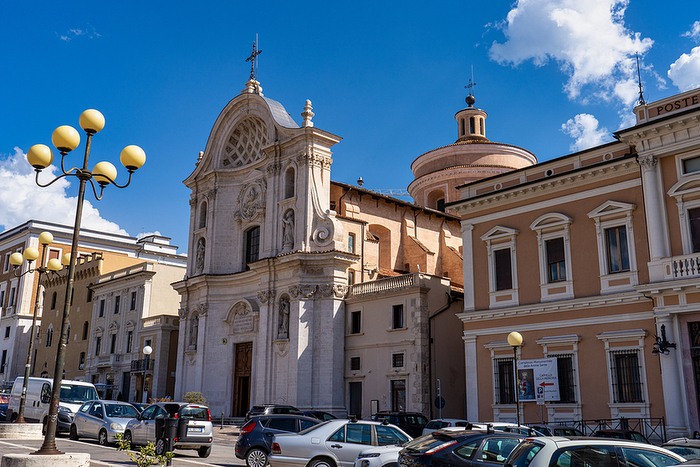
The historic centre and Piazza del Duomo
At the heart of the historic centre, Piazza Duomo (also known as Piazza del Mercato) is a large medieval square, framed by palazzi, cafés and churches, which regularly hosts markets. Current restoration work means that you can’t go inside the Duomo at present but there is a suggestion of it possibly re-opening this year. Other buildings on the square include the domed church of Santa Maria del Suffragio which has been restored and converted into a memorial for those who died in the earthquake.
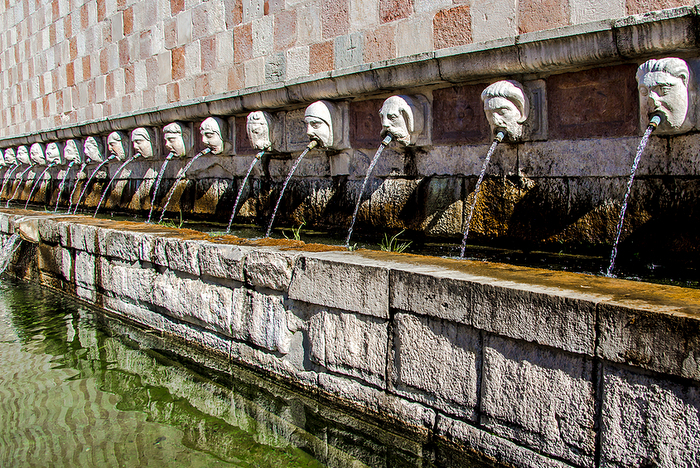
Fontana delle 99 Cannelle
L’Aquila’s most iconic monument is the medieval Fontana delle 99 Cannelle, a 99-spout fountain that extends along a late 13th century stone wall. Although, if you take the time to count them, you’ll find just 93 spouts! Each featuring a water-spouting unique ‘mascaron’, the spouts are believed to symbolize the 99 castles whose communities together founded L’Aquila in 1254.
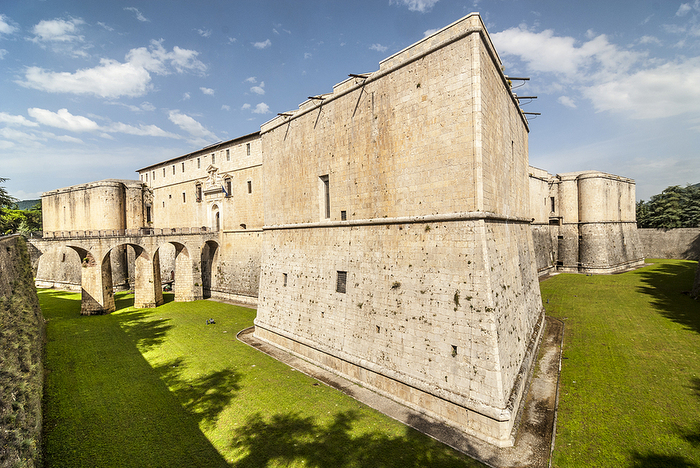
Forte Spagnolo
The Spanish Fort, also known as the Castello Cinquecentesco dell’Aquila, is an imposing 16th century citadel, with a wide moat and huge bastions. As of December 2025, it once again houses the highly regarded Museo Nazionale d’Abruzzo (MUNDA) which was relocated for a period during reconstruction works.
MAXXI art gallery
Set in the restored baroque Palazzo Ardinghelli, the gallery is an outpost of the Zaha Hadid designed MAXXI Foundation in Rome.
Other Basilicas and Churches
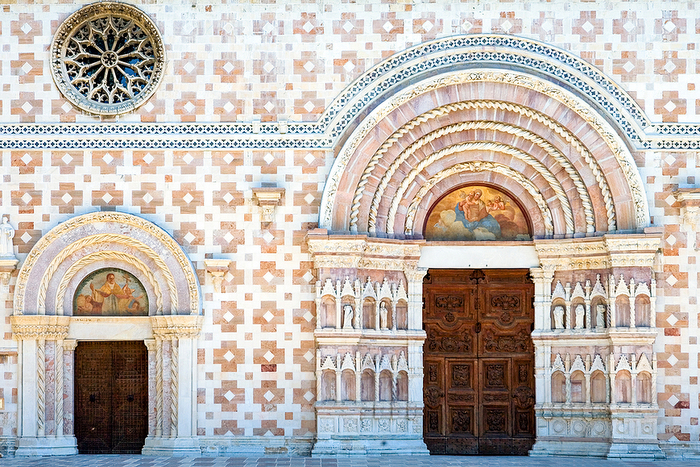
Set slightly outside of the historic centre, the immense Basilica di Santa Maria di Collemaggio cathedral is one of the city’s most striking sights. With a glorious pink and white stone façade and rose windows, the Gothic building contains important frescoes, the 16th century tomb of Pope Celestine V and the first Holy Door. Two other churches are also worthy of note. The Basilica of San Bernardino’s simple façade gives way to an ornate Baroque interior with graceful chapels, a huge central dome, gilt- covered wooden ceiling and grand gold-leafed organ. The 15th century mausoleum, which houses the relics of San Bernardino of Siena, is one of the region’s most important pieces of Renaissance artwork. Largely restored after significant damage, the 14th century Church of San Silvestro is a beautiful Gothic church with a rose window, bell tower and remnants of frescoes on the walls and ceilings.
Day trips from L’Aquila
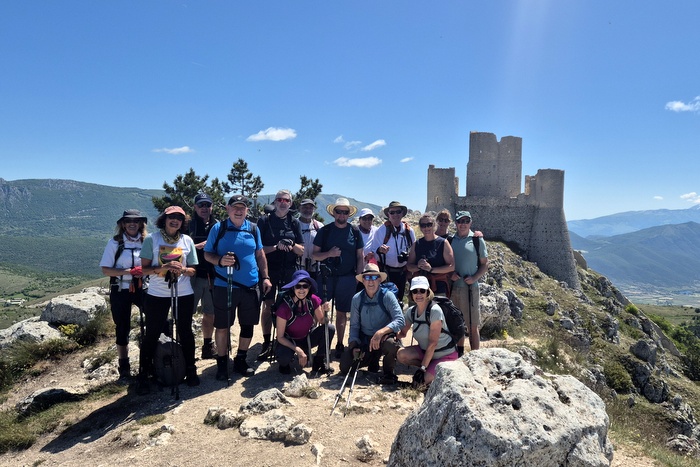
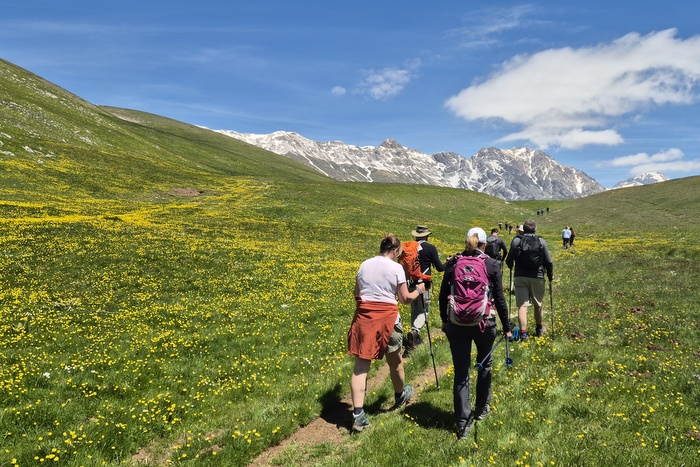
L’Aquila province is home to some of Italy’s most awe-inspiring mountain scenery – expect alpine meadows, dramatic cliffs and glacial valleys. Nature trails, canyons, forests and high plateaus are all easily accessible from the city – the Gran Sasso nature reserve is just 25 minutes by car from L’Aquila. Other national parks within a short drive of the city include the Monti della Laga National Park, the Majella National Park with its 500km of hiking trails and cave paintings, and the Sirente-Velino Regional Park. You may also want to visit Rocca Calascio, one of Italy’s highest medieval fortresses, or one or two of the region’s exceptionally beautiful towns and villages, such as Sulmona (1 hour by train). Read more in our regional guide to the Abruzzo.
What to eat in L’Aquila
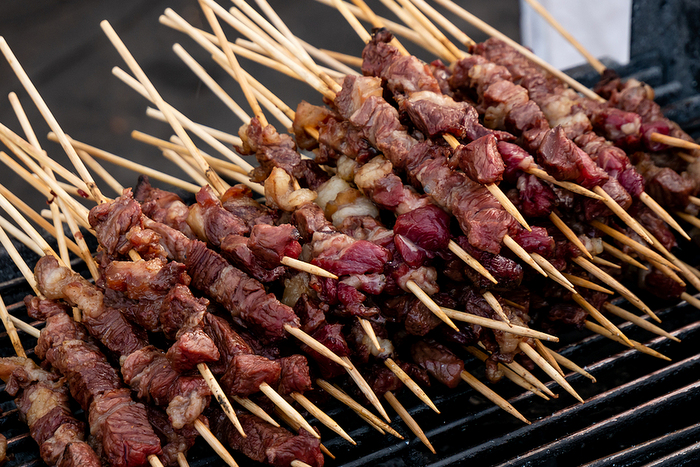
Largely influenced by its location and local traditions, ‘cucina povera’ dominates L’Aquila’s food scene. Artisanal foods, such as handmade cheeses and local reared meat, pasta, fresh seasonal vegetables and fruit (walnuts, figs and pomegranates) feature on menus and in restaurants. Traditional dishes include lamb – either ‘arrosticini’ skewers of lamb roasted over open coals or slow cooked lamb with herbs and vegetables. Traditional pasta includes macaroni ‘alla chitarra’, often accompanied by a rich ragù, or with a butter or cream sauce and a hint of saffron. The locally grown DOP saffron appears in a range of pasta and meat dishes. Most popular local wines include the widely consumed red Montepulciano d’Abruzzo which goes well with lamb dishes and pasta with meat sauces, and the white Trebbiano d’Abruzzo.
L’Aquila in literature
If you’re interested in exploring L’Aquila and the Abruzzo in fiction, contemporary novelist Donatella di Pietrantonio has set several of her highly regarded novels in the Abruzzo, where she grew up. Her 2014 book, Bella Mia (My Beautiful), set in L’Aquila, is a thought-provoking testament to family grief and survival following the 2009 earthquake. See our walking holiday reading list for more suggestions on novels set in the Abruzzo.
Getting to L’Aquila
Pescara (60km from L’Aquila) is the Abruzzo’s small regional airport, with a limited number of flights. You can also fly directly to Rome and transfer to L’Aquila by train (2-3 hours) from Roma Termini station. If you’re travelling by train from another major Italian city, Rome is the main transit hub. In some cases, you may find that travelling by bus is a faster option– for example, direct bus services such as Itabus connect Naples to L’Aquila in around 3 hours.
Why visit L’Aquila?
We love exploring smaller Italian cities that remain firmly off the tourist trail, and L’Aquila’s spectacular natural setting further enhances its appeal. Visiting any city during the staging of a festival or pageant is always a great way to get a feel for that place and its people, and L’Aquila regularly hosts annual events such as the historical-religious Perdonanza and a medieval jousting tournament. However, with over 300 cultural events organised in 2026 as part of L’Aquila’s Capital of Culture programme, this is the perfect time to get ahead of the curve and slot L’Aquila into your Italy itinerary.